Skip to content
davthecoder

Learning in public

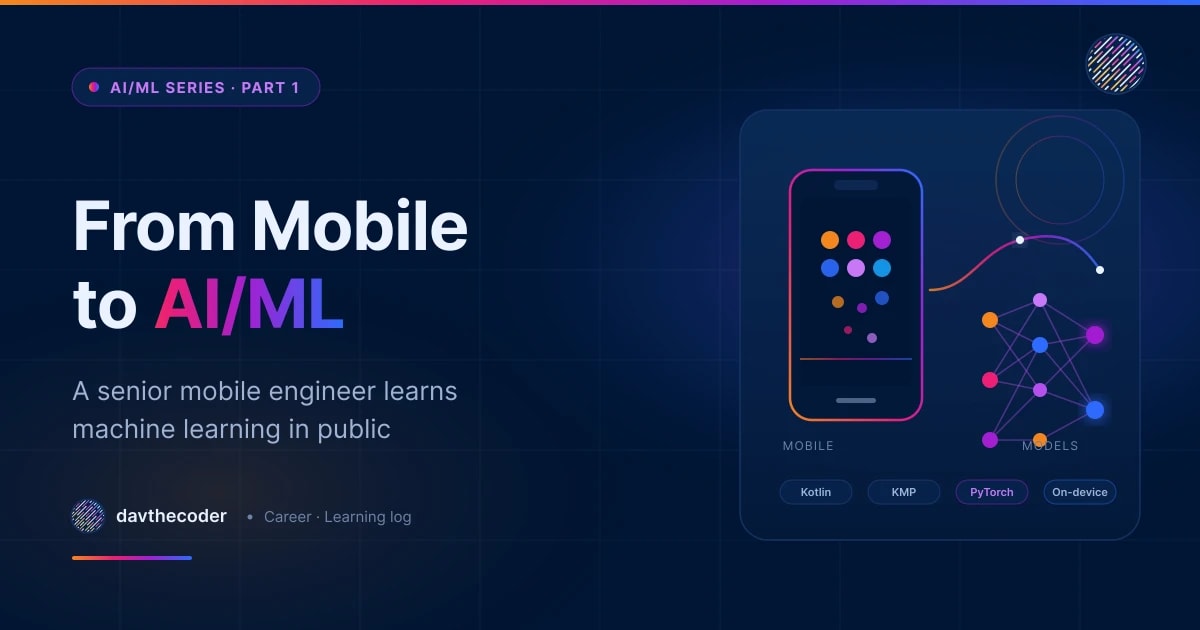
From mobile engineer to AI/ML engineer

I'm David Cruz Anaya. After 12 years shipping mobile products used by millions, I'm now documenting my move into AI/ML engineering in public. This page is the hub: the roadmap, the reading list, the projects, and the learning log. The honest version, including where I get stuck.

Why this move

The intersection is the opportunity

Most AI/ML engineers come from a data or research background. I come from 12 years of shipping production mobile software: Android apps used by millions at Sky, MGM, WWE and BritBox, a low-latency Kotlin Multiplatform audio SDK, and native Rust modules for performance-critical work.

That is not a disadvantage. The hardest, most valuable AI problems right now are not in the cloud, they are on the device: running models inside a battery and thermal budget, keeping latency under a frame, and shipping AI features that survive real users on real phones. The engineers who can do both, ship a model and ship an app, are rare.

I already build production LLM features for companies: tool calling, RAG, cost control, and evals (see the AI features service). What I am learning now is the deeper work: training, fine-tuning, MLOps, and the full ML engineering stack. This page tracks that journey.

The roadmap

What I am learning, in order

Six phases, from mathematical foundations to shipping an AI feature end to end. The status markers reflect where I actually am, not aspiration.

  1. In progressPhase 0

    Foundations

    • Linear algebra, calculus, and probability refresher (Mathematics for ML, Deisenroth et al.)
    • Python for ML: NumPy, pandas, matplotlib
    • Git, notebooks, and a reproducible local setup
  2. Up nextPhase 1

    Classical machine learning

    • scikit-learn: regression, classification, clustering
    • Feature engineering, cross-validation, and model evaluation
    • Hands-on: end-to-end project on a real dataset (Kaggle)
  3. Up nextPhase 2

    Deep learning

    • PyTorch fundamentals: tensors, autograd, training loops
    • CNNs for vision, RNNs/transformers for sequence data
    • Fast.ai / Deep Learning Specialisation (Coursera)
  4. Up nextPhase 3

    LLMs & applied AI

    • Transformers, attention, and tokenisation internals
    • Fine-tuning, RAG, and tool use with Hugging Face and the major APIs
    • Prompt engineering, evals, and cost control in production
  5. Up nextPhase 4

    On-device & edge ML (my edge)

    • TensorFlow Lite and Core ML integration on Android and iOS
    • On-device inference with Rust + KMP (the intersection with my existing work)
    • Quantisation, model compression, and latency budgets on mobile
  6. Up nextPhase 5

    MLOps & shipping

    • Model serving, monitoring, and drift detection
    • CI/CD for ML, experiment tracking (MLflow / Weights & Biases)
    • Building and shipping an AI feature end to end

The learning log

What I am writing about it

A series covering the move into AI/ML as a working mobile engineer: what I build, what works, and where I get stuck.

Reading list

The resources I am using

  • Mathematics for Machine Learning

    Book

    Deisenroth, Faisal, Ong

    The mathematical foundation, done properly.

  • Hands-On Machine Learning with Scikit-Learn, Keras & TensorFlow

    Book

    Aurélien Géron

    Practical ML and DL, end to end.

  • Deep Learning Specialization

    Course

    Andrew Ng, Coursera

    The standard deep learning course.

  • Practical Deep Learning for Coders

    Course

    Fast.ai

    Top-down, build-first teaching.

  • The Transformers Library

    Docs

    Hugging Face

    Working with pretrained models in practice.

  • Designing Machine Learning Systems

    Book

    Chip Huyen

    MLOps and the engineering of ML in production.

Follow the journey

I publish what I learn, what I build, and where I get stuck. No gatekeeping, no "I have always known this".