
Picture this: a 10-year veteran engineer, respected by peers, known for shipping complex systems… who suddenly tanks a technical interview.
They stumble on a coding puzzle, ramble through a a system design, or undersell themselves in a behavioural round. The result? Rejection.
Here’s the truth:
👉 Most senior dev failures in interviews aren’t about skill gaps.
They’re about misalignment between real work and the artificial game of interviews.
This post breaks down:
- Why seniors flop in interviews
- How to hack the process instead of losing to it
- Playbooks for both candidates and companies
✨ TL;DR (The Brutal Truth)
- Interview ≠ Job: Most processes test problem-solving tricks, not true senior engineering value.
- It’s about mechanics, not identity: You don’t fail because you’re bad you fail because you don’t “play the test.”
- Prep smart, not desperate: Learn the format, not just random problems.
- Companies can fix this: Shift focus to signals that actually predict senior impact.
🎭 1. Interview–Work Mismatch
💡 LeetCode ≠ Leadership.
Most interviews measure:
- Quick recall of algorithms
- 45-minute “snapshots”
- Problem-solving without rich context
But most senior value comes from:
- Designing systems and trade-offs
- Leading through messy, long-term challenges
- Mentoring and enabling teams
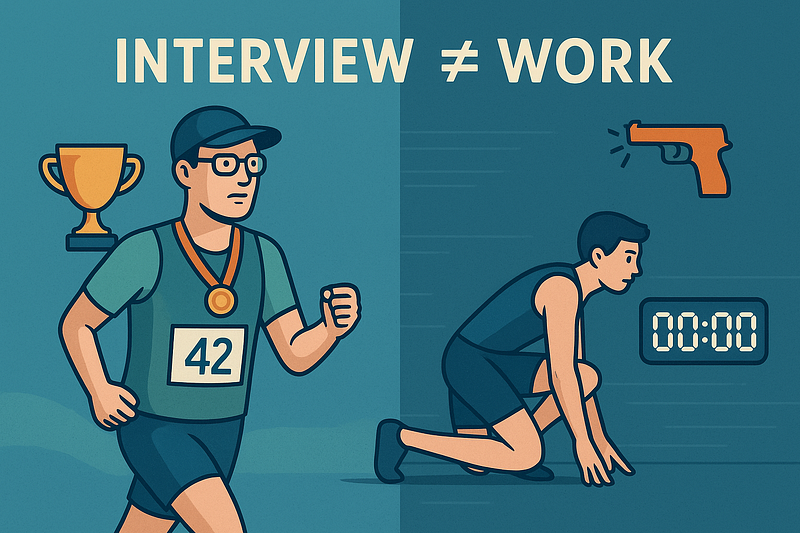
🗣️ Callout: “Interviews test how fast you sprint. Senior engineers win marathons.”
Playbooks:
- Candidates: Consider interviews to be a standardised test format mastery > raw depth.
- Companies: Use real work samples (debug sessions, refactors, collaborative design tasks).
🛠️ 2. Skill Rust & Role Drift
As seniors climb the ladder:
- They code less.
- They architect more.
- They rely on modern IDEs/tests/tooling.
Following that, the candidates are brought to an interview and placed in front of a whiteboard. This is when disaster strikes.
👉 Fix it:
- Candidates: Warm-up 2–3 weeks of daily short reps restores coding fluency.
- Companies: Let candidates use familiar tools.
🗣️ 3. Communication Gaps
Often, seniors know the answer. Problem? They don’t show their thinking.
- Silent problem solving = interviewer thinks you’re stuck
- Filling gaps = solving the wrong problem
- Behavioral round = vague “war stories” instead of structured, metric-backed wins
Mini Frameworks 🧩
- CODE (for coding): Clarify → Outline → Drive → Evaluate
- STAR+M (for behavioural): Situation → Task → Action → Result → Metrics
⚡ 4. Test-Taking Mechanics (The Hidden Curriculum)
The avoidable pitfalls:
❌ No clarifying questions
❌ Dive into code with no plan
❌ Forgetting edge cases & complexity
❌ Don’t timebox dead ends
Habit Stack → Always Run This Checklist:
- Restate problem + examples
- List edge cases
- Propose 2 approaches and talk about complexity
- Choose → implement incrementally → test
- Wrap with analysis and trade-offs.
🏗️ 5. System Design Pitfalls
It is ironic that seniors are the ones who have the most difficulty with system design. What is the reason?
- They boil oceans 🫠 instead of scoping first
- Hand-wave numbers instead of anchoring in reality
- Forget non-functionals like availability goals or back-pressure plans
🔥 Framework: DANCE-SCALER
Demand → APIs → Numbers → Constraints → Edges → Storage → Caching → Availability → Latency → Evolution → Reliability.
Pro tip: Keep quick math templates in your back pocket (QPS, storage, bandwidth). Numbers win credibility.
🎤 6. Behavioural Signals Seniors Miss
Seniors accidentally self-sabotage by:
- Saying “we” without clarifying “I”
- Hiding failures (when real leaders show learning loops)
- Delivering outcomes too vague (“improved performance”)
👉 Replace with:
“Reduced p95 latency from 480ms to 190ms (↓60%), saving $3.2k/mo.”
Hack: Create a “story bank” of 8–12 STAR+M examples with metrics.
Here are some common questions that you may be asked:
- Can you provide an example of a time when you took on a leadership role for a team?
- Tell me about a time you faced a significant technical challenge. How did you overcome it?
- Describe a time you had to work collaboratively with others to achieve a goal.
- Give me an example of a time you assumed leadership for a team.
🎲 7. Bias & Miscalibration
- Interviewer inconsistency
- Domain mismatch (“fintech lead tested on ads puzzle”)
- Ageism + résumé filtering
Control what you can: Candidates should focus on mechanics and clarity. For companies, enforce rubrics, training, and double scoring.
🗓️ 8. Senior Prep Plan (2–4 Weeks)
- Days 1–3: Baseline → code+design dry run, build story bank
- Days 4–10: Daily drills → coding + system design + behavioral stories
- Days 11–14: Do mocks, record yourself, fix pacing
- Days 15–28: Tune to company’s formats/tech stacks
✅ 9. Quick Checklist
Coding: Constraints → 2 approaches → incremental testing → trade-offs
System Design: Demand, SLOs, quick math, failure modes
Behavioral: STAR+M, highlight you, include failure story
Print this. Tape it to your desk.
🏢 10. For Hiring Teams
Want better signals?
- Define senior rubrics (judgment, scope, teaching impact)
- Prefer work samples > puzzles
- Train interviewers and enforce structure
- Let seniors use realistic tools
🎯 Final Words
Senior developers don’t fail because they can’t build, They fail because interviews are a different game with different rules.
👉 As a candidate: Learn the rules, master the mechanics, and tell your story with clarity & metrics.
👉 As a company: Measure what matters judgement, trade-offs, and how seniors elevate teams.
Loading comments…